
Maurice Müller
Senior Content Manager
Maurice Müller is a journalist and content strategist with experience across print and digital media. At Formalize, he translates complex compliance and regulatory topics into clear, practical content for compliance, risk, and security professionals across Europe.
Key takeaways:
ISO 27001 certification doesn't make you NIS2 compliant, but your ISMS evidence gives the gap analysis a head start.
Check scope first. You set your ISO scope yourself, while the directive and national law set your NIS2 scope.
The usual gaps sit where NIS2 adds legal duties: management approval and training, reporting within 24 and 72 hours, and a view of each direct supplier's security risks.
Give every requirement a status, a priority, an owner, a next action and a date, and take the result to management.
National law and sector rules decide the details, so check them before you treat ISO evidence as sufficient.
Teams that already run a certified ISMS start NIS2 with a real advantage. Their risk assessments, policies, incident procedures and supplier clauses are audited every year, and the Article 21 measures overlap with much of Annex A in ISO/IEC 27001:2022. The EU Agency for Cybersecurity (ENISA) even maps the detailed requirements for certain digital providers to ISO/IEC 27001:2022 in its technical implementation guidance, though a mapping doesn't prove equivalence. Where the two differ is in the question they answer. ISO 27001 asks whether your management system works for the scope you chose. NIS2 asks whether your organization, as the law defines it, meets duties that come with deadlines, named recipients and personal accountability for management. Getting from ISO 27001 to NIS2 is a much smaller job than starting from zero.
Before mapping controls, check whether your ISO certification covers the relevant NIS2 scope
Your ISO 27001 certificate only counts as NIS2 evidence within its own scope. Under clause 4.3, you choose which parts of the organization, which locations and which systems belong to the ISMS, and many certificates are limited to a single product, a data center or the IT department. NIS2 leaves you no such choice. Article 21 applies to the network and information systems an entity uses for its operations or to provide its services, and the directive and your national law decide which legal entities are in scope.
Before you compare any controls, put four documents next to the result of your NIS2 scoping:
Certification scope: the legal entities, sites, services and systems your ISO 27001 ISMS covers.
Statement of Applicability (SoA): the controls you apply from Annex A, the ones you excluded and why.
Current risk register: whether the risks extend beyond what the certificate covers.
Control evidence: the records your last audit actually sampled, such as logs, review minutes and test results.
Then confirm which national law applies, whether you're an essential or an important entity, and whether sector rules add detail. Cloud, data center and managed service providers, among others, follow Implementing Regulation (EU) 2024/2690, which sets the measures out in more detail. National law can also define what your certificate is worth, and member states don't all treat it the same way.
Example: Belgium. ISO/IEC 27001 is one of the routes the Centre for Cybersecurity Belgium (CCB) recognizes for essential entities to show conformity. Those taking it had to submit their certification scope, SoA and latest internal audit report by 18 April 2026. Certification is due by April 2027, and its scope has to cover the entity's networks and information systems, with narrow exceptions.
ISO 27001 to NIS2 gap analysis: what can you reuse and what remains?
Use the table as a working assessment rather than a legal mapping. For each row, check whether the ISO record exists, whether the process behind it runs across your whole NIS2 scope, and whether you could show it to an authority. A policy on file is only the first of those three checks. Then give each row your own status and priority, as described in the action plan below. The legal wording is in Directive (EU) 2022/2555, and national law may add to it.
NIS2 requirement area | Existing ISO 27001 evidence to review | What to test or add for NIS2 | Suggested owner |
|---|---|---|---|
Management oversight and training (Art. 20) | Management review minutes (clause 9.3), leadership (5.1), roles and responsibilities (5.3) | Approval of the measures by the management body, follow-up on implementation, training records for each member | Management body, prepared by the CISO |
Risk analysis and security policies (Art. 21(2)(a)) | Risk assessment and treatment (6.1.2, 6.1.3), risk register, information security policy | Risks for all network and information systems of the entity, with an all-hazards view including physical threats | CISO or risk lead |
Incident handling and reporting (Art. 21(2)(b), Art. 23) | Incident procedure (A.5.24 to A.5.28), incident log, contact with authorities (A.5.5) | Significance criteria, the national reporting contact, a 24-hour, 72-hour and one-month workflow, report approval, informing service recipients, a timed exercise | Security operations, with legal |
Business continuity and crisis management (Art. 21(2)(c)) | Security during disruption (A.5.29), ICT readiness (A.5.30), backups (A.8.13), redundancy (A.8.14) | Recovery plans exercised for critical services and systems, restore tests, a crisis team with clear communication | Business continuity lead and IT operations |
Supply chain security (Art. 21(2)(d), 21(3)) | Supplier policy and agreements (A.5.19 to A.5.22), cloud services (A.5.23), supplier register | Risks specific to direct suppliers and service providers, a criticality ranking, contract terms on incidents and audits | Procurement, with the CISO |
Secure development and vulnerability handling (Art. 21(2)(e)) | Vulnerability management (A.8.8), secure development (A.8.25 to A.8.29) | Vulnerability handling and disclosure, including reports from outside | IT or product security |
Effectiveness, cyber hygiene and training (Art. 21(2)(f), (g)) | Monitoring and measurement (9.1), internal audit (9.2), awareness training (A.6.3) | Metrics and audits covering the NIS2 measures, cyber hygiene for all staff, prompt corrective action (Art. 21(4)) | ISMS manager, with HR |
Access, assets, cryptography and authentication (Art. 21(2)(h) to (j)) | Cryptography (A.8.24), HR security (A.6.1 to A.6.6), access control (A.5.15 to A.5.18), asset inventory (A.5.9), secure authentication (A.8.5) | Where appropriate: multi-factor or continuous authentication, secured voice, video and text communications, secured emergency communication | IT operations |
Which gaps should an ISO 27001 certified team address first?
Start with significant-incident reporting and management accountability. These are the duties with deadlines and personal accountability attached, and the ones an ISO audit is least likely to have tested. Continuity and suppliers come next. The NIS2 incident reporting pack checklist helps you prepare the reporting side in advance.
Test the significant-incident reporting process
An ISO incident procedure is built to contain incidents and learn from them. Few procedures say who decides that an incident is significant under Article 23(3), who approves the report to the computer security incident response team (CSIRT) or competent authority, or how the early warning goes out within 24 hours of becoming aware of the incident. The incident notification follows within 72 hours and the final report one month after that, plus intermediate reports on request. Run a tabletop exercise and time each step, from the first alert to the drafted early warning. Our overview of NIS2 requirements covers the full set of obligations.
Record management decisions and responsibilities
ISO 27001 asks top management to show leadership and review the ISMS. Article 20 of NIS2 goes further: the management body approves the cybersecurity risk-management measures, oversees their implementation and can be held liable for infringements, and its members have to follow training. The directive doesn't say how to document this, though national guidance may. Useful evidence includes dated approvals, minutes where management reviewed progress and decided on open risks, a named accountable person for each area, and a training record for every member. A management review that only noted the audit report is unlikely to demonstrate that oversight.
Check continuity and supplier evidence across your NIS2 scope
Most ISMS documentation already includes a continuity plan and a supplier policy, which makes both areas look covered on paper. Article 21(2)(c) names backup management, disaster recovery and crisis management, so check that continuity plans have been exercised beyond the certified scope and that backups have been restored. Article 21(3) asks you to take into account the vulnerabilities specific to each direct supplier and service provider, and the quality of their products and cybersecurity practices. Check that what you know about your critical suppliers is current, and that contracts cover incident notification and your right to verify.
Turn your findings into a NIS2 action plan
A gap table only helps if every row ends with a decision. Apply the same five steps to each one:
Mark status and priority: existing evidence, partial evidence or gap, and how urgent it is.
Name the owner: a person who can implement or verify the measure.
Record the next action: for example, update an escalation procedure or test a recovery plan.
Set a date and the evidence: decide what will show that the action is done.
Review with management: record decisions, accepted risks and what stays open.
The example below applies the steps to a common gap: an ISO incident procedure without a tested NIS2 notification workflow.
Step | Entry |
|---|---|
Status | Partial evidence, high priority. The incident procedure (A.5.24 to A.5.26) and incident log exist. Significance criteria, an authority contact and a 24-hour step are missing. |
Owner | Head of security operations, with legal counsel approving every report |
Next action | Significance criteria based on Article 23(3) and national guidance, a decision step with a named deputy, the reporting channel and a template for each report |
Exercise | Tabletop: ransomware at your hosting provider on a Friday evening. The clock starts at awareness. Record when the incident was classified and when the early warning was ready. |
Evidence | Versioned procedure, exercise log with timestamps, lessons learned with follow-up tasks, management sign-off |
Date | Internal targets, not legal deadlines: procedure within four weeks, exercise within six, results at the next management review |
Not sure how far along you are overall? The NIS2 Compliance Self-Assessment gives you a first score and the areas to look at.
Manage ISO 27001 and NIS2 work in one place
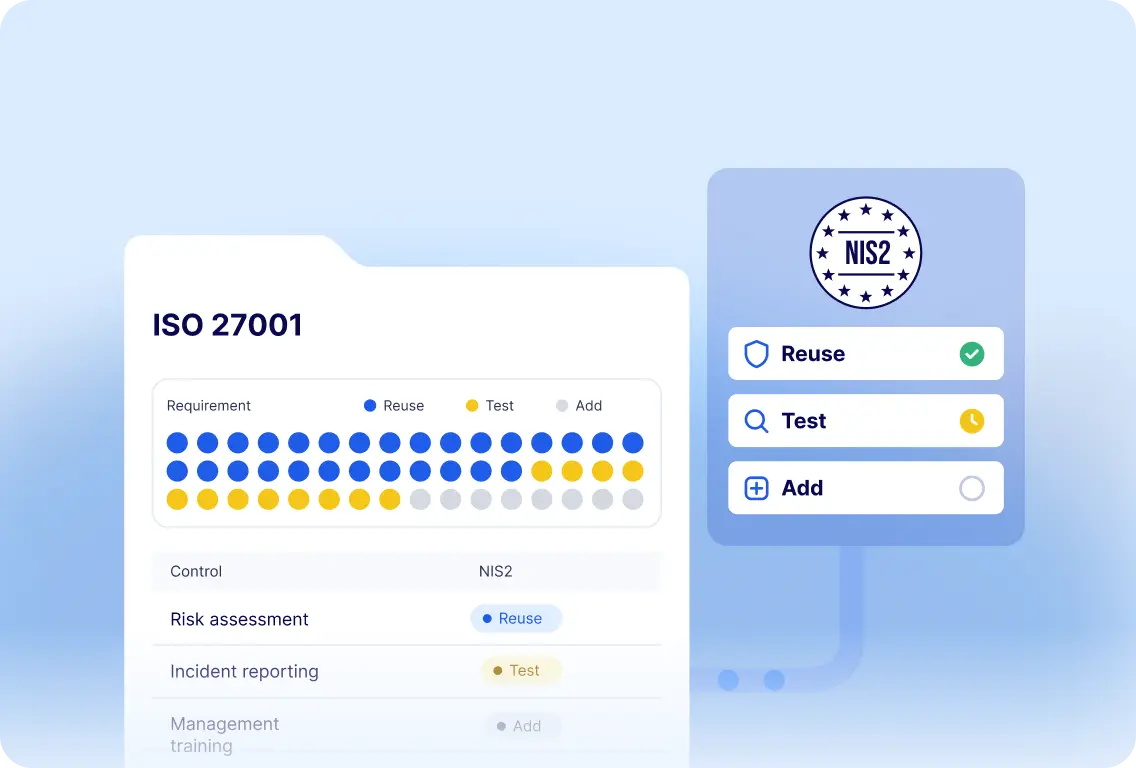
Formalize keeps both frameworks in one system, so the gap analysis doesn't end up in another spreadsheet. Start from the NIS2 Compliance Blueprint, or a national NIS2 Blueprint where your law is in force, and map the controls you already run for ISO 27001 to the NIS2 requirements. Each requirement gets an owner, tasks with due dates and linked evidence. Management approvals are timestamped, and the 24-hour, 72-hour and one-month reports run as tasks with their own owners. Supplier questionnaires sit next to your risks and controls, and official ISO 27001 content is built into the platform.
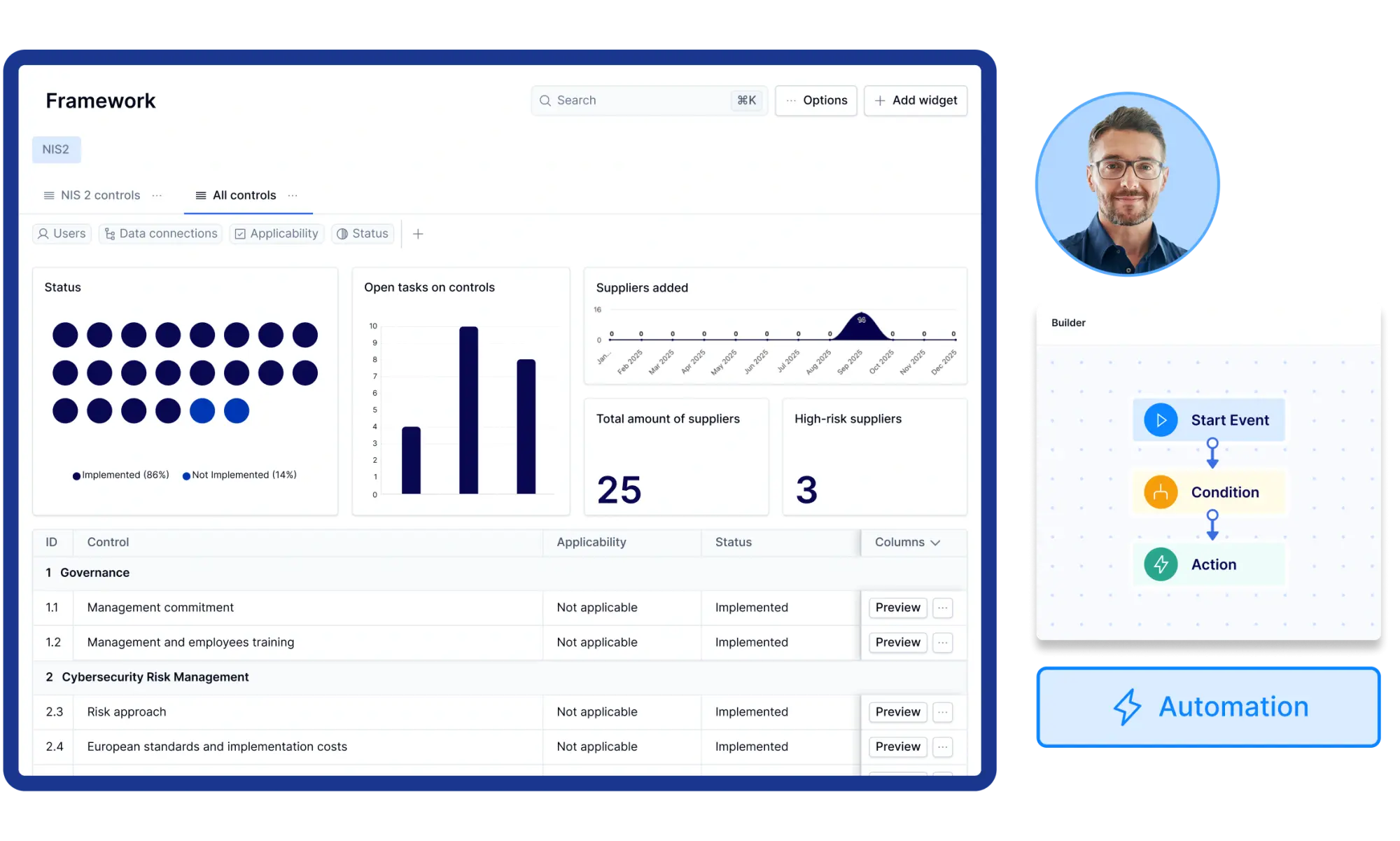 Formalize structures the work. Your team still decides whether each measure is implemented and which national requirements apply. Learn more about our NIS2 compliance software.
Plan the NIS2 work on top of your ISMS
Bring your SoA and your last audit report. We'll show you how to map them to NIS2 and set up the remaining work with owners and dates.

Frequently asked questions
This article is for information only and doesn't constitute legal advice.