
Maurice Müller
Senior Content Manager
Maurice Müller is a journalist and content strategist with experience across print and digital media. At Formalize, he translates complex compliance and regulatory topics into clear, practical content for compliance, risk, and security professionals across Europe.
Key takeaways:
SOC 2 ends in an attestation report from an independent auditor on your controls, measured against the Trust Services Criteria of the American Institute of Certified Public Accountants (AICPA). There is no SOC 2 certification.
ISO 27001 sets requirements for an information security management system (ISMS). An accredited certification body issues a certificate for three years, with surveillance audits in between.
Start with the one your customers ask for. SOC 2 is common with North American buyers, while ISO 27001 is recognized internationally.
Access control, risk assessment, incident response and supplier management overlap, so one set of controls and evidence can support both. Neither replaces the other.
If a customer's security questionnaire asks for SOC 2 and your next prospect wants ISO 27001, the SOC 2 vs ISO 27001 question stops being theoretical. Both show that you manage information security, but they come from different bodies and end in different documents: SOC 2 in a report on your controls, ISO 27001 in a certificate for your management system. Which one you need first depends on who you sell to, where, and how far your security program has come. Many organizations end up with both.
What is SOC 2?
SOC 2 is an examination framework from the AICPA. An independent CPA firm examines the controls of a service organization, such as a SaaS or cloud provider, and reports on them against the AICPA's Trust Services Criteria. The criteria cover five categories:
Security: in scope for every SOC 2 examination. These are also called the common criteria.
Availability, processing integrity, confidentiality and privacy: included when they matter to the services you provide and the commitments you make to customers.
There are two report types. A Type 1 report assesses the design of your controls at a specific date. A Type 2 report also tests whether they operated effectively over a period, typically 12 months, and sometimes as short as three months for a first report.
The result is an attestation report, not a certificate. Its use is restricted to specified parties, so you share it with customers and prospects, usually under a non-disclosure agreement, rather than posting it publicly.
The criteria themselves are about to change. In October 2026, the AICPA published an exposure draft of updated Trust Services Criteria. The draft restructures the criteria and adds points of focus for AI governance. If approved, it would apply to engagements beginning on or after 31 December 2027, with early adoption permitted. Comments are open until 15 January 2027. Until a final version is issued, SOC 2 examinations use the 2017 criteria.
What is ISO 27001?
ISO/IEC 27001 is the international standard for establishing, implementing, maintaining and continually improving an information security management system. The current edition is ISO/IEC 27001:2022, amended in 2024 to ask whether climate change is a relevant issue for the ISMS. Certificates based on the 2013 edition expired on 31 October 2025.
The standard is built in two layers:
Clauses 4 to 10: mandatory management system requirements, such as defining the scope, assessing and treating risks, setting objectives, running internal audits and management reviews, and correcting nonconformities.
Annex A: a reference list of 93 controls in four themes: organizational, people, physical and technological. You select the controls your risk assessment calls for and justify each choice in a Statement of Applicability.
Certification is optional, and ISO itself doesn't certify anyone. An accredited certification body audits your ISMS within the scope you define and issues the certificate. Our guide What Is ISO 27001? ISMS & Certification Guide covers the standard in more depth.
What are the key differences between SOC 2 and ISO 27001?
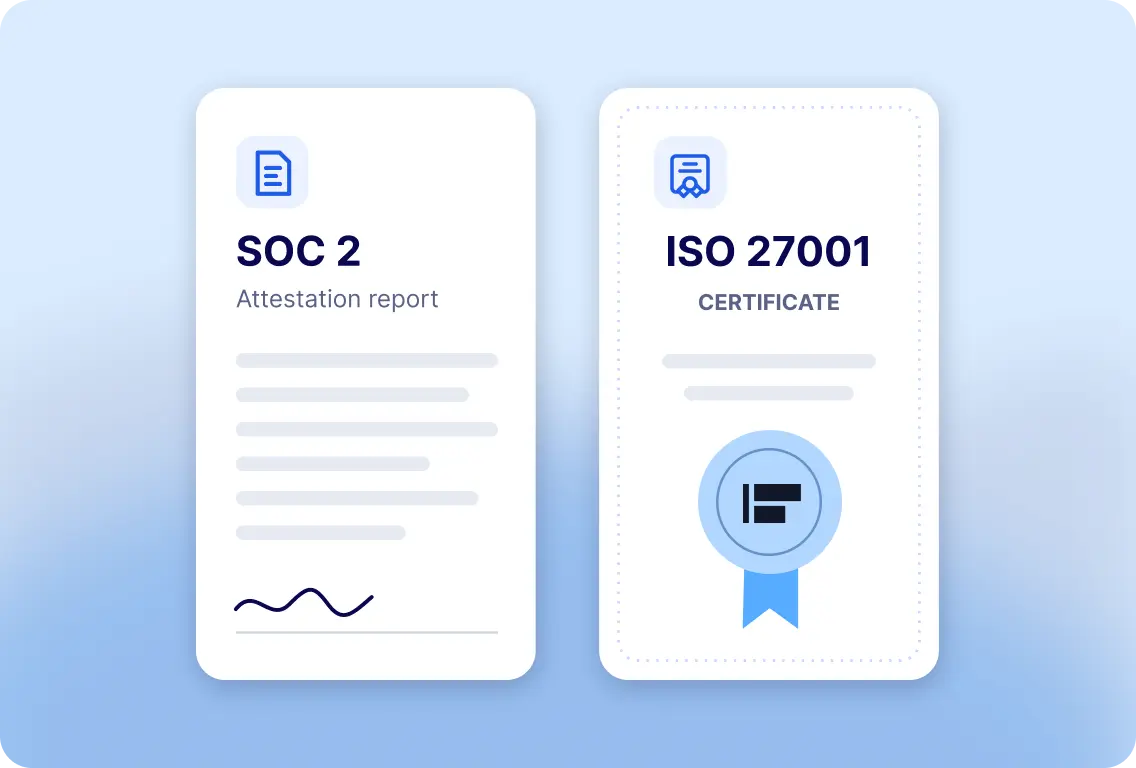
SOC 2 and ISO 27001 address many of the same security risks, but they assess different things. SOC 2 is an attestation: a CPA firm tests your controls against the AICPA's Trust Services Criteria and issues a report. ISO 27001 is a certification: an accredited certification body audits your information security management system and issues a certificate.
SOC 2 | ISO 27001 | |
|---|---|---|
Main focus | Controls relevant to the Trust Services Criteria you select | A management system that runs and improves information security |
Framework | AICPA Trust Services Criteria (2017, revised points of focus 2022) | ISO/IEC 27001:2022 international standard |
Outcome | Attestation report with the auditor's opinion | Certificate stating that the ISMS meets the standard within its scope |
Assessed by | Independent CPA firm | Accredited certification body |
Controls | Designed by you to meet each criterion | Selected from Annex A based on risk, justified in the Statement of Applicability |
Sharing | Restricted to specified parties, usually under NDA | Certificate can be shown publicly |
Ongoing assessment | Type 2 covers a defined period and is usually renewed every year | Annual surveillance audits, recertification every three years |
Where it's asked for | Especially common with North American customers | Recognized internationally, across industries |
Neither is stricter across the board. Which one fits comes down to your customers and what you need to prove.
Differences in requirements and controls
SOC 2 starts from criteria. For each one, you describe how your controls meet it, and the auditor tests those controls. The AICPA doesn't prescribe a control list, so two SOC 2 reports can look quite different.
ISO 27001 starts from the management system. Clauses 4 to 10 are mandatory: you can't leave out the risk assessment, the internal audit or the management review. Annex A controls are chosen by risk, and the Statement of Applicability explains why each one is included or excluded.
Certification vs attestation
An ISO 27001 certificate confirms that your ISMS meets the standard within its defined scope. It is short, public and easy to verify. A SOC 2 report is long and detailed: it describes your system, lists your controls, and, in a Type 2 report, shows how the auditor tested them and any exceptions found.
That is also why "SOC 2 certification" is a misnomer: what you get is a SOC 2 report, Type 1 or Type 2, not a certificate.
SOC 2 Type 2 vs ISO 27001
Many security questionnaires accept either a SOC 2 Type 2 report or an ISO 27001 certificate, because both are independent checks that go beyond a single day. They still check different things:
SOC 2 Type 1 | SOC 2 Type 2 | ISO 27001 certificate | |
|---|---|---|---|
What is checked | The design of your controls | The design of your controls and whether they operated effectively | Your ISMS against clauses 4 to 10 and the Annex A controls in your Statement of Applicability |
Time covered | One date | A review period, usually three to twelve months | The certification audit, then surveillance audits every year |
Result | Attestation report | Attestation report | Certificate |
Renewal | No fixed cycle | Usually every year, for the next period | Recertification every three years |
Geographic recognition and business requirements
SOC 2 comes from the US accounting profession and is what many North American customers ask for in vendor reviews. ISO 27001 is recognized worldwide and often asked for in European and international procurement. For organizations in the EU, much of the ISMS work also supports the risk management measures in Article 21 of the NIS2 Directive, although a certificate doesn't make you NIS2 compliant on its own. Our article NIS2 Requirements: Key Pillars & Checklist lists those measures.
These are tendencies, not rules. The most reliable guide is what your current and target customers put in their contracts and questionnaires.
SOC 2 vs ISO 27001: Which one should you choose?
Look at your business model, your customers' requirements, your target markets and the security processes you already run.
When to choose SOC 2
You provide SaaS, cloud or other technology services.
Your customers ask for a SOC 2 report by name.
You sell to enterprise customers in North America.
You want to show how specific controls for security, and possibly availability or confidentiality, work day to day.
When to choose ISO 27001
You want to set up or formalize an ISMS.
You sell across several international markets.
Your customers' procurement requires ISO 27001 certification.
You want a structured, risk-based way to manage information security as the organization grows.
When to choose both
Organizations serving customers in several regions often need both, because buyers expect different proof. A typical path: a SaaS company gets a SOC 2 Type 2 report for its first US customers, then adds ISO 27001 certification when European and international buyers start asking for it. Others go the other way. There is no correct order, and the second framework takes less work when the first one's controls and evidence can be reused.
Manage SOC 2 and ISO 27001 side by side
See how Formalize links a control across both frameworks, with its owner, its evidence and the Statement of Applicability.

What do SOC 2 and ISO 27001 have in common?
Both expect you to manage information security risks and to prove it. That comes down to the same building blocks:
Risk management: identifying, assessing and treating information security risks.
Access management: restricting access to systems and data, and reviewing it regularly.
Security policies: documented requirements and responsibilities, approved by management.
Incident management: preparing for, responding to and learning from security incidents.
Supplier management: assessing and monitoring the suppliers that handle your data.
Monitoring and documentation: keeping evidence that controls exist and work.
Meeting one framework doesn't automatically satisfy the other. ISO 27001 adds management system requirements that SOC 2 doesn't have, and SOC 2 asks for a description of your system and controls set against each criterion, which ISO 27001 doesn't.
ISO 27001 vs SOC 2 mapping: Can you reuse existing controls?
Yes, to a large extent. Control mapping documents which SOC 2 criteria and which ISO 27001 requirements or Annex A controls one control supports. Done well, it shows three things: where one control covers both, where it covers only part, and where something is missing.
Some typical overlaps. They are examples, not a complete or official mapping:
Area | SOC 2 Trust Services Criteria | ISO 27001:2022 |
|---|---|---|
Risk assessment | CC3.1 to CC3.4 | Clauses 6.1.2 and 8.2 |
Security policies | CC5.3 | Clause 5.2, Annex A 5.1 |
Access control | CC6.1 to CC6.3 | Annex A 5.15 to 5.18 |
Logging and monitoring | CC7.2 | Annex A 8.15 and 8.16 |
Incident management | CC7.3 to CC7.5 | Annex A 5.24 to 5.27 |
Change management | CC8.1 | Annex A 8.32 |
Business continuity and backup | CC9.1, A1.2 and A1.3 | Annex A 5.29, 5.30 and 8.13 |
Suppliers | CC9.2 | Annex A 5.19 to 5.22 |
Internal audit | CC4.1 | Clause 9.2 |
Take access management. One access control policy, approved by management, supports both frameworks. A quarterly review of employee access rights, assigned to a named owner, produces the same evidence each time: the list of users reviewed, the changes made and the sign-off. That evidence can serve the SOC 2 auditor testing CC6 and the ISO 27001 auditor checking Annex A 5.18. What changes is the context: ISO 27001 also wants the control in your Statement of Applicability and the related risk in your risk treatment plan.
A mapping spreadsheet is a good place to start. The AICPA offers members an Excel mapping of the Trust Services Criteria to ISO 27001, dated May 2018. That is before ISO/IEC 27001:2022 was published, so check it against the current Annex A. Whatever mapping you use, confirm it with your auditors, because overlapping controls don't make the frameworks identical.
SOC 2 vs ISO 27001: How do costs and timelines compare?
There is no general answer to which one costs more. It depends on your size, scope, security maturity and auditor. The figures below are published estimates that depend on scope, not quotes.
SOC 2 costs: auditor fees, readiness work, implementing missing controls and collecting evidence throughout the review period. As an estimate, the CPA firm Linford & Co puts SOC audit fees at $20,000 to $150,000, with a median of around $30,000.
ISO 27001 costs: building the ISMS, the certification audit, surveillance audits in the following two years and recertification in the third. As an estimate, GRC Solutions puts the certification audit at about £7,500 for an organization with 11 employees and £16,250 for one with 126, based on a day rate of £1,250. Implementation is usually the largest part of the total cost, according to the same source.
SOC 2 timeline: a Type 1 report reflects a single date. A Type 2 report needs controls operating over the whole review period before the auditor can issue it. The CPA firm Cherry Bekaert describes one to two months for readiness, one to six months for remediation, three to twelve months for a Type 2 review period and about one month until the report is issued.
ISO 27001 timeline: after implementation, a Stage 1 audit checks your readiness and documentation, and a Stage 2 audit checks whether the ISMS works in practice. Surveillance audits follow at least once a calendar year, and the certificate is renewed every three years. The certification body Schellman puts preparation for certification at three months to a year.
Existing controls: if you already run documented security processes, both take less preparation.
Can you achieve SOC 2 and ISO 27001 at the same time?
Many organizations do, and run one program for both, because the controls and documentation overlap:
Define the scope: decide which systems, services and teams each framework covers.
Map overlapping requirements: link each control to the SOC 2 criteria and ISO 27001 requirements it supports.
Run a gap assessment: list what each framework needs beyond the shared controls, such as the ISO 27001 management review or the SOC 2 system description.
Assign control owners: give each control a named person who keeps it running.
Collect evidence once: store each piece of evidence so it can support both assessments.
Coordinate audits: plan the SOC 2 review period and the ISO 27001 audits around your readiness.
Maintain compliance: keep monitoring controls, managing risks and updating documentation.
Running both at once avoids duplicate work, but it needs more coordination and, in the first year, more people's time.
How compliance software supports SOC 2 and ISO 27001
With two frameworks, the hard part is keeping track: which control serves which requirement, who owns it, and whether the evidence is still current. Compliance software keeps that in one place. In Formalize:
Frameworks side by side: the ISO 27001 framework produces a Statement of Applicability, and the official ISO/IEC 27001:2022 text can be added as an add-on through Formalize's collaboration with ISO. SOC 2 is set up as your own framework (there's no ready-made SOC 2 blueprint today), and its controls can be linked to the ISO 27001 controls you already run.
Shared controls: you link a control in one framework to its counterpart in the other, so its status and evidence can carry over. You define the mapping, and Formalize IQ, the platform's AI assistant, can suggest overlaps and run a gap analysis on your own data.
Owners and tasks: each control has a responsible person, and recurring tasks with deadline notifications cover work like access reviews.
One evidence library: a piece of evidence can support several controls, keeps its version history and shows when it expires.
Risks and policies: a risk register with inherent and residual scoring, and policies with approval flows and acceptance tracking.
Internal audits: the Audit module runs internal audits, as ISO 27001 requires, with findings tracked to closure.
Formalize helps you organize and document the work. The SOC 2 report comes from your CPA firm, and the ISO 27001 certificate from your certification body.
Frequently asked questions
This article reflects information available on 20 November 2026. It is general information, not legal or audit advice. Confirm scope and requirements with your auditor or certification body.