
Maurice Müller
Senior Content Manager
Maurice Müller is a journalist and content strategist with experience across print and digital media. At Formalize, he translates complex compliance and regulatory topics into clear, practical content for compliance, risk, and security professionals across Europe.
Key takeaways:
A risk management framework (RMF) is a structured, repeatable system for identifying, assessing, treating, and monitoring risk.
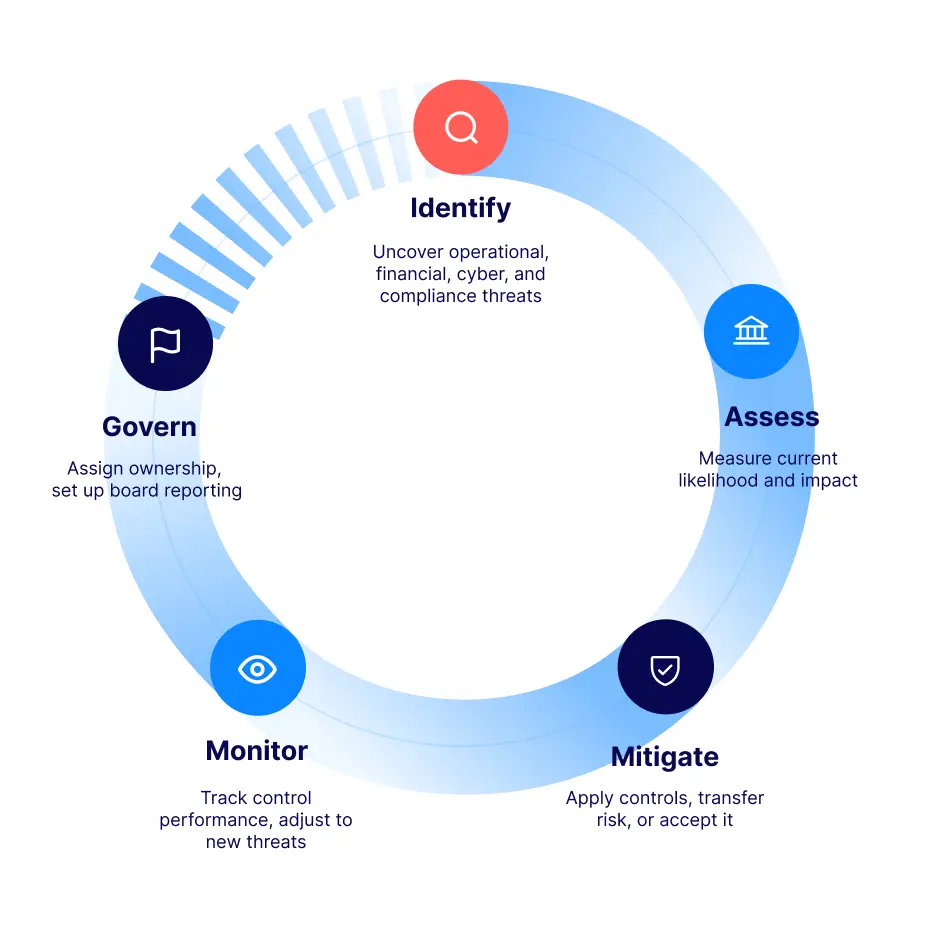
Most frameworks converge on a similar rhythm, commonly summarized as identify, assess, mitigate, monitor, and govern.
The major frameworks include ISO 31000, NIST RMF, NIST CSF, COSO ERM, and COBIT, each built for a different purpose.
The right framework depends on your industry, your size, and what you already have in place.
Third-party and AI risk each now have their own dedicated frameworks.
Regulatory scrutiny keeps growing. Cyber threats keep evolving. Ad hoc risk tracking, a spreadsheet here, an email thread there, doesn't hold up under either pressure. A risk management framework gives organizations a structured blueprint instead. It protects business assets. It does so in a way that scales as the organization grows.
That's the real value. Not just spotting risk, but handling it the same way every time, regardless of who's doing the work. A framework also gives different teams a shared language. Security, finance, and operations can all point to the same register and mean the same thing by "high risk." Without that shared language, risk conversations tend to stall on definitions instead of decisions.
What is a risk management framework (RMF)?
A risk management framework is a repeatable process to identify, evaluate, and mitigate organizational risk. It gives every risk decision the same starting point: the same categories, the same scoring logic, the same review cycle.
That consistency is what fragmented spreadsheets can't provide. A spreadsheet can list risks. It can't enforce that every risk gets scored the same way, reviewed on schedule, or escalated when it should be. As the number of risks grows, and as more people touch the register, that gap turns into blind spots. A framework closes it by defining the process once and applying it everywhere.
Most frameworks share three underlying components. A common vocabulary for describing risk. A defined process for moving from raw threat to managed risk. And a way to prove, later, that the process actually happened. That third piece matters more than it sounds. A regulator or auditor rarely asks whether you thought about a risk. They ask you to show it.
A simplified five-step risk management process
The specific standards below differ in structure and terminology, and their activities aren't always strictly sequential. NIST RMF uses seven steps. NIST CSF 2.0 uses six functions. ISO 31000 uses five stages with different names again. Underneath the differences, though, most frameworks converge on the same recurring activities. Here's a simplified version, useful for comparing frameworks at a glance, not an official model in its own right:
 1. Identify
Uncovering potential operational, financial, cyber, and compliance threats before they become incidents. This step casts wide on purpose. A threat left off the list at this stage never gets assessed later.
2. Assess
Measuring how likely a risk is and how much impact it would have today, whether that's the inherent risk if nothing has been done yet, or the current risk level if some controls already exist. That measurement is what determines whether a risk needs mitigation at all, or falls within what the organization can already tolerate.
3. Mitigate
Applying internal controls, transferring risk through insurance or contracts, or formally accepting risk that falls within tolerance. Each control comes with an expected residual risk, the level the risk should drop to once it's actually in place. Not every risk needs a control. Some are cheaper to accept than to fix, and a good framework makes that an explicit decision, not a default.
4. Monitor
Tracking whether the actual, resulting risk matches the residual risk mitigation was expected to produce, and adjusting controls as new threats appear. A control that worked last year can quietly stop working as systems, vendors, and staff change. Monitoring is what catches the gap between expected and actual before an incident does.
5. Govern
Assigning ownership at the leadership level, and setting how risk gets reported to the board. Without a named owner, risk tends to default to whoever raised it first, not whoever is actually accountable for it.
Most common types of risk management frameworks
Each framework below was built to solve a different problem. That's the main reason to know the differences. Picking the wrong one means solving a problem you don't actually have.
Framework | Focus area | Typical users |
|---|---|---|
ISO 31000 | General risk principles and process, any industry | Risk managers, general businesses |
NIST RMF | Certifying and authorizing individual information systems | US federal agencies, contractors |
NIST CSF | Organization-wide cybersecurity posture | CISOs, security teams |
COSO ERM | Integrating risk with strategy, performance, and culture | Boards, executive teams |
COBIT | IT governance and technology-business alignment | IT governance leads, auditors |
ISO 31000
ISO 31000 is a global standard that sets out risk management principles and a process, not a certifiable checklist. Its process runs through establishing context, risk assessment, risk treatment, and monitoring and review, with communication and consultation running throughout. It applies to any organization, any size, any industry, which makes it the most common starting point for a general risk program.
Because it isn't certifiable, nobody audits you against ISO 31000 the way they would ISO 27001. That's a feature for most organizations, not a gap. It means you can adopt the parts that fit and skip the ceremony that doesn't, without needing to pass an external audit to prove it.
NIST RMF and NIST CSF
These are two separate NIST publications, and mixing them up is a common mistake. NIST RMF, formally SP 800-37, runs seven steps (Prepare, Categorize, Select, Implement, Assess, Authorize, Monitor) to certify and authorize individual information systems. It's most common in the US federal space and among contractors, though its structure has been adopted well beyond that.
NIST CSF is a separate, broader framework for an organization's overall cybersecurity posture. The current version, CSF 2.0, released in February 2024, organizes work into six functions: Govern, Identify, Protect, Detect, Respond, and Recover. Govern was added in this version specifically, reflecting how much weight governance now carries across the whole framework.
Neither is a certification you can obtain. Both give you a shared vocabulary for cybersecurity risk instead. Many organizations end up using both: RMF for system-level authorization, CSF for the broader program that sits above it.
COSO ERM
COSO's Enterprise Risk Management framework, updated in 2017, is built for a different audience than the two above. It focuses on integrating risk with business strategy, performance, and corporate culture, not on technical controls. It's organized into five components: Governance and Culture, Strategy and Objective-Setting, Performance, Review and Revision, and Information, Communication, and Reporting, spanning 20 underlying principles.
COSO ERM, like ISO 31000, carries no certification. Boards and executive teams adopt it voluntarily, to show risk is genuinely built into how the company runs, not bolted on separately. That makes it less useful for cybersecurity-specific work, but more useful when the audience for the risk conversation is the board rather than an IT team.
COBIT
COBIT, maintained by ISACA, is built specifically for IT governance rather than risk management in general. Its current version, COBIT 2019, organizes 40 governance and management objectives across five domains. One domain covers governance itself. The other four cover management activities like planning, building, running, and monitoring IT.
Organizations tend to reach for COBIT when the goal is aligning technology decisions with business objectives. Risk management shows up as one thread running through that broader governance work, not as the framework's primary purpose. COBIT is often described as a framework for managing other frameworks. It sits above tools like ISO 27001 or NIST, rather than replacing them.
Third-party and AI risk frameworks
Vendor relationships and AI systems have each earned their own dedicated frameworks, because neither fits cleanly into the frameworks above. Third-party risk management (TPRM) covers the risk a vendor or supplier introduces to your organization. It's an area regulations like DORA and NIS2 increasingly expect organizations to formally manage, not assume away. A vendor's weak security posture becomes your risk the moment they touch your data or your systems.
On the AI side, the NIST AI Risk Management Framework, published in 2023, organizes AI-specific risk into four functions: Govern, Map, Measure, and Manage. It's voluntary, and there's no audit or certificate attached to it. For organizations that want a certifiable equivalent instead, ISO 42001 covers AI management systems the way ISO 27001 covers information security. Expect more organizations to ask for one or the other as AI systems become a standard line item in vendor security reviews.
How to choose the right framework for your organization
These three factors do most of the work in narrowing this down:
Industry and regulatory requirements
A healthcare organization and a software vendor face different obligations, and those obligations often point toward different frameworks. Financial services firms under DORA, for instance, need a framework that can absorb ICT risk in the way DORA expects, which pulls most of them toward NIST-style or ISO 31000-based approaches over COBIT.
Organization size and complexity
A smaller organization with one risk owner and a handful of systems doesn't need COBIT's 40 objectives. It needs something it can actually run consistently. A larger organization with more moving parts can absorb more structure, and often needs it to keep risk visible across departments.
Your current compliance stack
If you already hold ISO 27001, building on ISO 31000 keeps your risk language consistent. If you're mapping toward NIS2 or a NIST-aligned federal contract, NIST RMF or CSF gives you controls that map more directly. Choosing a framework that fights your existing stack instead of extending it creates duplicate work that shows up again the next time you're doing this exercise.
None of these factors work in isolation. A mid-market financial services firm under DORA, for instance, sits at an intersection. Regulated industry, moderate complexity, and often an existing ISO 27001 certification already in place. That combination usually points toward extending what's already there. It rarely points toward something built for a different context, like COBIT's IT-governance focus or COSO's board-level lens.
See how this maps to your own risk register
Bring your current framework, or the spreadsheet standing in for one. We'd rather map it against your actual setup than describe a fit in the abstract.
Risk management framework examples by use case
Put more simply, here's how that plays out by use case:
Organization or objective | Possible starting point | Why |
|---|---|---|
General enterprise risk program | ISO 31000 or COSO ERM | Covers risk across departments and business objectives |
Board-level strategic risk | COSO ERM | Connects risk with strategy and performance |
Cybersecurity program | NIST CSF 2.0 | Provides outcome-based cybersecurity guidance |
US federal system or contractor | NIST RMF | Supports security and privacy risk management and authorization |
Enterprise IT governance | COBIT 2019 | Connects information and technology with enterprise governance |
AI governance program | NIST AI RMF and/or ISO 42001 | Addresses AI-specific risk and management processes |
These are starting points, not final answers. Most organizations end up combining two frameworks rather than picking exactly one, the same way NIST RMF and CSF are commonly used together
Managing risk management frameworks with Formalize
Most organizations start their risk register in a spreadsheet, and most eventually outgrow it. A spreadsheet can hold a list of risks. It can't automatically re-score a risk when a control fails, remind an owner that a review is overdue, or show an auditor a live, consistent record instead of last quarter's export.
The gap tends to show up at the worst possible time, usually right before an audit or a board review, when someone realizes the spreadsheet hasn't been updated since three people left the team.
Formalize's unified risk assessment tool lets teams map custom or pre-built risk controls, score risks consistently, and monitor them continuously instead of re-running the exercise manually each quarter. For organizations managing risk across frameworks rather than just one, Formalize's all-in-one risk management platform keeps that work in a single system instead of parallel spreadsheets per framework. And because vendor risk rarely stays separate from the rest of the risk register for long, Formalize's third-party risk management (TPRM) capability keeps supplier risk in the same system as everything else, rather than in its own disconnected process.