

Maurice Müller
Senior Content Manager
Maurice Müller is a journalist and content strategist with experience across print and digital media. At Formalize, he translates complex compliance and regulatory topics into clear, practical content for compliance, risk, and security professionals across Europe.
Key takeaways:
GDPR Article 35 requires a DPIA whenever processing is likely to result in a high risk to the rights and freedoms of individuals.
Unlike conventional risk assessments, a DPIA weighs potential harm to people, not primarily financial, operational, or cybersecurity risk to the organization.
Three types of processing automatically trigger one: large-scale profiling with legal effects, large-scale special-category or criminal data processing, and large-scale monitoring of public areas.
At minimum, it has to cover what's being processed, whether that's necessary and proportionate, the risks to individuals, and the safeguards planned to address them.
If a high residual risk can't be sufficiently mitigated, the controller has to consult the relevant supervisory authority before processing goes ahead.
A DPIA centers on the people whose data gets processed, not on the organization doing the processing. The DPIA meaning overlaps substantially with a privacy impact assessment (PIA), an older, broader term for the same kind of exercise, used across data protection regimes outside the EU and, in the UK, in guidance that predates GDPR itself. In practice, many organizations and even some regulators use the two terms interchangeably, and the underlying methodology is largely the same: mapping data flows, assessing risk to individuals, and defining safeguards. The distinction that matters legally is narrower: under GDPR specifically, DPIA is the defined term, with the triggers and content set out in Article 35 and the consultation requirement in Article 36. That focus on people rather than the organization shapes everything else about how it works.
Why are DPIAs important?
Catching a privacy problem before launch beats discovering it afterward. That's the practical case for a DPIA: it surfaces risk while a project can still be redesigned around it, rather than after launch, when the options narrow to damage control. It also happens to be one of the clearest ways to demonstrate GDPR accountability, not by pointing to a policy, but by showing the actual reasoning behind a specific processing decision.
None of this requires eliminating every risk a DPIA turns up. The job is to identify what's there, decide whether it's acceptable, and put the right safeguards around it. Done early enough, that same exercise embeds data protection into how a project is designed, instead of bolting privacy on as a review step at the end.
When is a DPIA required under GDPR?
Article 35 sets the trigger: a DPIA is required whenever processing is likely to result in a high risk to the rights and freedoms of individuals. Whether that threshold is met comes down to the nature, scope, context, and purpose of the processing itself, not the size of the organization running it.
Processing that automatically requires a DPIA
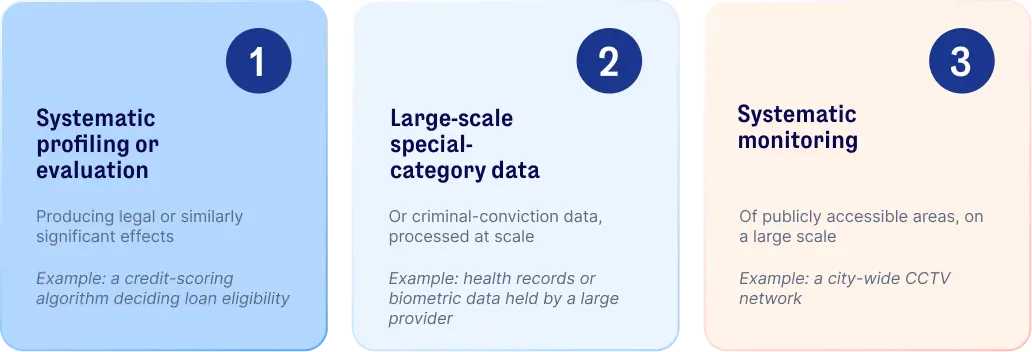
Three scenarios always cross that line, according to GDPR Article 35:
Systematic and extensive profiling or evaluation that produces legal or similarly significant effects. A credit-scoring algorithm that decides loan eligibility is a clear example.
Large-scale processing of special-category or criminal-conviction data, such as health records or biometric data, at scale.
Systematic monitoring of publicly accessible areas on a large scale, like a city-wide CCTV network.
 Other indicators of high-risk processing
Those three scenarios are the minimum, not the complete list. Systematic monitoring, sensitive data, large-scale processing, combining datasets from different sources, processing that involves vulnerable individuals, innovative technologies, and automated decision-making can all push processing into high-risk territory even outside the named scenarios. National supervisory authorities publish their own lists too, like the UK ICO's DPIA guidance, and those often go further than GDPR's own examples.
What kind of risk does a DPIA assess?
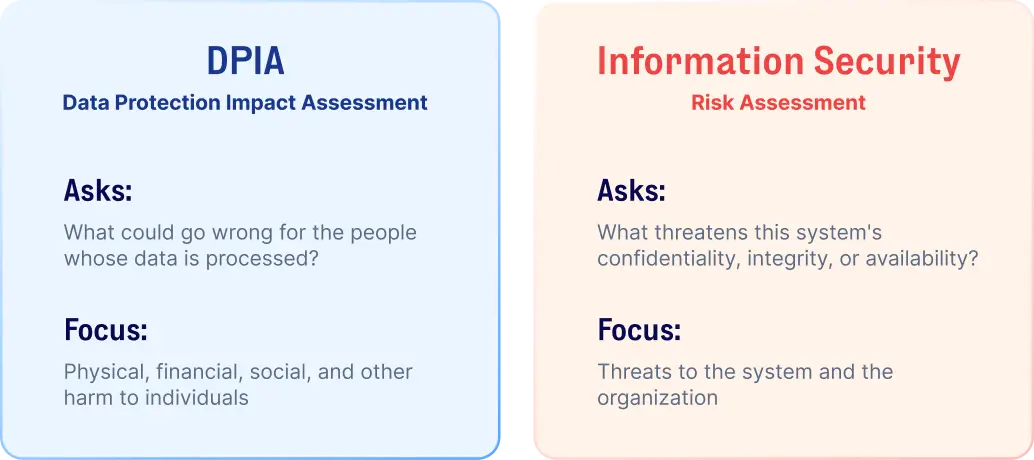
A DPIA asks about physical, financial, social, or other material and non-material harm to individuals. Discrimination resulting from an automated decision, identity theft following a data breach, or simply losing control over sensitive personal data all count as harm to the person, regardless of whether the organization itself ever faces a consequence. It's a genuinely different question from the one a conventional risk management framework asks, which typically evaluates risk to the organization itself rather than to the people its processing affects.
DPIA vs. information security risk assessment
An information security risk assessment typically focuses on threats to confidentiality, integrity, and availability. Consequences for the individuals involved are what a DPIA is actually built to catch. Security controls often end up doing double duty as DPIA mitigation measures, but running an information security assessment under ISO 27001 doesn't substitute for one. They're answering different questions, even when they're looking at the same systems.
What should a DPIA include?
GDPR Article 35 sets four minimum elements:
DPIA element | What it means in practice |
|---|---|
Description of the processing | What data is collected, how, and for what purpose |
Necessity and proportionality assessment | Whether this processing is actually needed to achieve the purpose, and no more invasive than it has to be |
Risk assessment | What could go wrong for the individuals involved, and how likely and severe that would be |
Safeguards and measures | What's being done to address the identified risks and demonstrate compliance |
See your DPIAs connected to a real privacy program
Book a demo or start a free trial to see how Formalize supports DPIAs and the rest of your GDPR program in one place.
How to conduct a DPIA
These seven steps cover the process. How much time each one needs depends on how complex the processing actually is:
Determine whether a DPIA is required. Check the processing against the automatic triggers above, or against your organization's own documented criteria if none apply directly.
Describe the processing activity and data flows.
Assess necessity and proportionality. Could the same purpose be achieved with less data, or a less invasive method, before assuming the current approach is the only option?
Identify risks to individuals. Not "a breach could happen" in the abstract, but what that breach would actually mean for the people affected, exposure, reputational harm, financial loss.
Define measures to reduce those risks. Technical controls, process changes, or contractual terms with a processor, matched to the specific risk identified in step four.
Record decisions, responsibilities, and outcomes.
Integrate the outcome into the project and keep it under review.
A single processing activity with well-understood data flows might move through all seven in a day. A new product involving profiling, third-party data sharing, and automated decisions earns considerably more time at steps three and four specifically.
Who is responsible for conducting a DPIA?
The data controller is responsible for ensuring a DPIA gets carried out when one is required. That's a formal accountability, not necessarily a solo task: where an organization has a Data Protection Officer, their advice belongs in the process, and relevant teams, processors, and technical specialists often contribute information or expertise along the way. Responsibility and contribution are two different things here, and conflating them is a common way accountability quietly disappears.
When should a DPIA be conducted?
GDPR expects a DPIA early enough to actually shape how the processing gets designed, and always before high-risk processing begins. By the time the system is already built, a DPIA becomes a formality: the architecture is set, the vendor is chosen, and changing any of it now means real cost and delay. Treating a DPIA as part of project planning, rather than a compliance sign-off tacked on at the end, is what actually connects it to GDPR's broader principle of data protection by design and by default.
Does a DPIA need to be reviewed?
Nothing about a completed DPIA is permanent. A new vendor might take over part of the processing, a system might start collecting an additional data field, or a model built for one purpose might get repurposed for another. Any of these can quietly invalidate the original assessment, without anyone deciding it should. Article 35(11) requires a review where necessary, and at least when the risk posed by the processing changes. In practice, that means revisiting a DPIA when the nature, scope, context, or purpose of the processing changes, when new technology enters the picture, when new risks emerge, or when the safeguards originally put in place change materially. Treat it as a living process, not a document filed away once it's approved.
What happens if a DPIA identifies a high residual risk?
The first response is to look for measures that reduce the risk. If, even after mitigation, the processing would still result in a high risk to individuals, the controller has to consult the relevant supervisory authority before the processing goes ahead. That's a distinct trigger from the one that starts a DPIA in the first place: an initial high risk means a DPIA is required, while an unmitigated high residual risk means the authority needs to be consulted before proceeding.
Is there a standard DPIA template?
GDPR doesn't mandate a single format. It defines what a DPIA has to cover, then leaves organizations free to use a template published by a supervisory authority or adapt their own methodology, as long as the required elements are genuinely addressed.
The European Data Protection Board adopted a harmonized DPIA template (version 1.0), intended as a common reference across the EU, in March 2026 and published it that April. Public consultation on the draft closed in June 2026, and at the time of writing, the EDPB's own page still describes the final version as pending. It's worth watching, but it isn't yet the single required format.
How Formalize supports DPIA management
Most organizations still keep their DPIAs in documents, spreadsheets, and email threads. That leaves no single view of which assessments are outstanding, overdue, or quietly out of date.
Formalize keeps that work in one structured system instead:
DPIA and TIA workflows with named owners and deadlines, not a document waiting in someone's inbox.
Processing activities connected to risks, systems, and suppliers, so a DPIA reflects what's actually happening, not a snapshot from when it was written.
Evidence and safeguards attached directly to each risk, so a completed DPIA can actually be produced on request, not reconstructed from memory.
GDPR, ISO 27001, NIS2, and other frameworks in the same system, instead of scattered across separate tools that each need their own update.
None of that determines whether a specific DPIA is legally sufficient. That judgment still belongs to the people who understand the processing and its context. What Formalize does is make that judgment easier to document, evidence, and revisit later.